 1
Bridge over the River Kwai
2 hours
Walk across on the central walkway; trains still cross it. About 3 km north of town, songthaews run along Saeng Chuto Rd
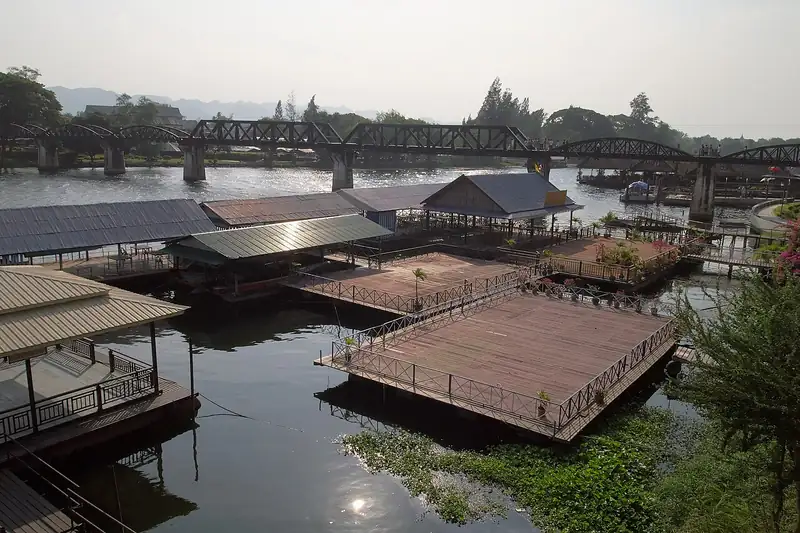
Kanchanaburi is a relaxed river town west of Bangkok, best known for the bridge on the Death Railway that prisoners of war and Asian workers were forced to build.
Kanchanaburi is a relaxed river town west of Bangkok, best known for the bridge on the Death Railway that prisoners of war and Asian workers were forced to build. Visit the war cemetery and the railway museum first: they give the bridge its meaning. Then head out to Erawan's tiered waterfall or the Hellfire Pass memorial. In the evening, eat by the river or sleep in a floating raft house.
Updated 20 Nov 2026. Words from our research of Wikivoyage and Wikipedia, written by Trip720; figures from our checked data, each with its source.
What it costs
Sources: thailandstarterkit.com, thaiholidayguide.com, kamnuan.vercel.app; in AUD at today's rate.
Not to miss
In Kanchanaburi first, day trips last.
12 hours
Walk across on the central walkway; trains still cross it. About 3 km north of town, songthaews run along Saeng Chuto Rd
 2
2 hours
The best of the Death Railway museums; 09:00-17:00, 160 baht, next to the war cemetery
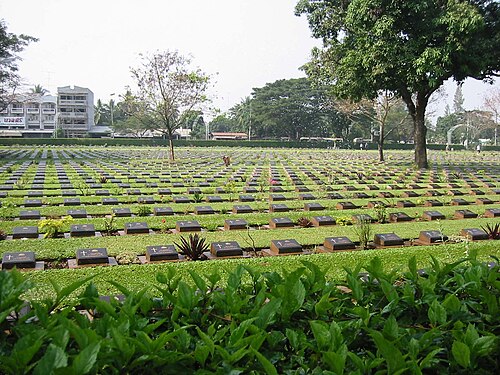 3
2 hours
Commonwealth War Graves cemetery opposite the railway station; free, open 07:00-14:00
2 hours
Limestone cave temple 5 km out of town past Chungkai War Cemetery; combine with a bicycle ride on the west bank
A full day
Ride the surviving line over the bridge and along the cliff-hugging Wang Pho viaduct at Tham Krasae; the 10:30 train has a tourist carriage
A full day
Hotels and agencies sell full-day packages with driver, lunch and park fees; the only practical way to see both in one day
Half a day
Guided or self-guided paddles on the Kwai Yai and Kwai Noi rivers from operators on Mae Nam Khwae Rd
 8
Half a day
Day trip: 35 km from Kanchanaburi
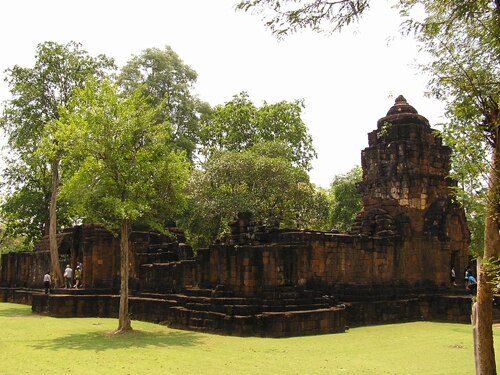
Khmer-style laterite sanctuary beside the Kwai Noi about 40 km west; quiet and rarely crowded
2 hours
Day trip: 50 km from Kanchanaburi
Wooden POW-built viaduct hugging the cliff above the River Kwai, with a cave shrine beside the station; reached by the Nam Tok train or road
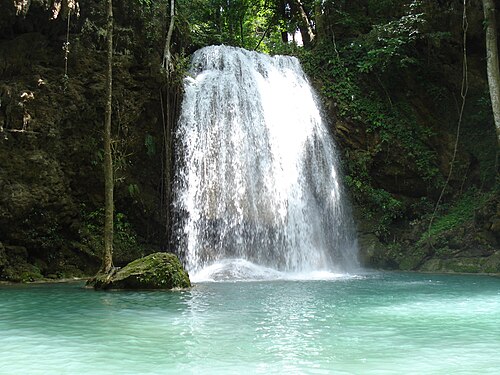
Seven tiers of turquoise pools about 65 km from town; bring swimwear and good shoes. Bus 8170 from the bus terminal, about 90 min
From our research of travel guides; ticket prices from Tiqets when we found them. Photos: Wikimedia Commons, free licences.
How to see it
Grouped so you never cross the town twice. Your own trip moves these around your dates, opening days and budget.
Where to sleep
Where you sleep in Kanchanaburi decides how much you walk and how you spend your evenings. Your trip prices the stays for your dates.
Most guesthouses, bars and restaurants line this road. Easy and social, but it can be noisy at night.
Floating rooms on the river, peaceful and cool. Book ahead; many offer free pickup.
Close to the war cemetery and the street food stalls. Handy for trains, less river view.
What to eat
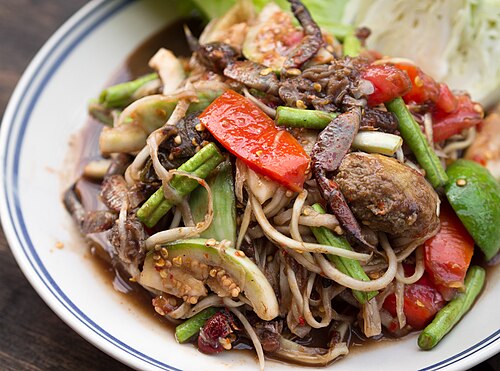
Spicy green papaya salad pounded with lime, chilli and peanuts.

Minced meat salad with herbs, lime and chilli.

Minced meat stir-fried with holy basil and chilli, served over rice.

Hot and sour soup with prawns.
Dish photos: Wikimedia Commons, free licences.
When to go
Best months30° and overAverage daytime high
Pleasant days and the least rain.
7 mm of rain on average.
Up to 37° in the afternoon. September is the wettest month (220 mm).
Source: NASA POWER climatology.
Good to know
Official source: smartraveller.gov.au, checked 2026-10-01. Your plan checks your own passport when you build it.
The war cemeteries are places of grief. Dress modestly, speak softly and never sit on the graves.
The walkway has gaps in the railings and trains still cross. Step aside when one comes.
Arrive early to beat crowds, wear good shoes and bring a towel. Watch for hornets at the top tier.
Public transport between Hellfire Pass and Erawan is limited. A tour or hired driver fits both into one day.
Foreign cards pay a fee on every ATM withdrawal. Take out larger amounts less often.
Cover shoulders and knees at working temples, and take off your shoes before entering halls.
Questions
Food and getting around come to about A$12 a person a day eating street food, A$20 with a balanced mix and A$35 eating mostly in restaurants, before your stay and activities.
The most pleasant months are November and December. December is the driest month (7 mm of rain) and September the wettest (220 mm); daytime highs run from 30 to 37 °C over the year.
No visa needed for a holiday. Checked on smartraveller.gov.au on 2026-10-01; rules change, so check again before you book.
Bridge over the River Kwai, Thailand-Burma Railway Centre, Kanchanaburi War Cemetery, Wat Tham Khao Pun cave temple, Death Railway train ride to Nam Tok.
Tell us your total. We build the whole trip to fit it, every cost counted.
Header photo: Vyacheslav Argenberg, CC BY 4.0, Wikimedia Commons. Photo credits