Phuket in December: longtail boats, a white Buddha on a hill, and the quiet end of the island
By Mia and Tom, a couple from Sydney · · Eight nights at the start of the dry season, between the sea caves of Phang Nga and the sunset crowd at Promthep Cape.
I should say at the start that I did not want to go to Phuket. I had a picture of it in my head, and the picture was Bangla Road at midnight, and I am not a Bangla Road at midnight person. Tom, who is, won the toss. What I did not know is that Phuket is an island fifty kilometres long with a loud bit at the top of the west coast and a great deal of quiet everywhere else, and that December is when the sea goes flat and the sky stays clear and the whole place looks like the brochure for once.
Boats, first
The Phi Phi day started at a pier full of speedboats and ended with me asleep on Tom's shoulder with salt in my hair. The boats go out in a convoy, bounce for an hour, and then the limestone starts: cliffs straight out of the water, orange and grey, with trees growing out of nothing. Maya Bay is viewing only now, from the boat, which I was glad about after seeing how many of us there were. The snorkel stops were the point for me: the water so clear I could see Tom's feet three metres down, and fish the colour of highlighter pens that were plainly used to being fed.
Phang Nga Bay, two days later, was better and I will fight anyone about it. You go out on a bigger boat and then a Thai paddler takes you two at a time in an inflatable canoe into the hongs, the sea caves, lying flat on your back to get under the rock at the entrance, bats above you, and then the cave opens into a lagoon inside the island with mangroves and a circle of sky. Nobody talks in there. The paddler had a cigarette behind his ear the whole time and never lit it. James Bond Island is on the way back, a thin rock standing in the sea, and everyone takes the same photograph, including us.
Up the hill, into town
The Big Buddha sits on top of the island, forty-five metres of white marble that you can see from half the beaches, and the road up is the kind where Tom stopped talking and held the door handle. Shoulders and knees covered, shoes off, and then the whole of the south of the island laid out below you, Chalong Bay one side, Kata the other, with the sound of a bell and somebody's grandmother lighting incense. Wat Chalong on the way down is the busiest temple on the island and feels it, firecrackers going off in a brick chimney to thank the monks for prayers answered, which made me jump every single time.

The Old Town was my favourite afternoon. Thalang Road is a row of Sino-Portuguese shophouses, pink and mint and pale yellow, with shutters and tiled floors and a hundred years of tin money behind them. On Sunday evening they close the road and it becomes a walking street, grilled squid and mango sticky rice and a man selling roasted chestnuts out of a wok the size of a satellite dish. We ate at a stall, standing up, and I bought a paper fan I did not need. The elephant sanctuary that morning was the thing Tom had been quiet about wanting: no riding, no tricks, just old elephants eating bananas out of your hand with a trunk that is somehow both enormous and polite.
The beaches
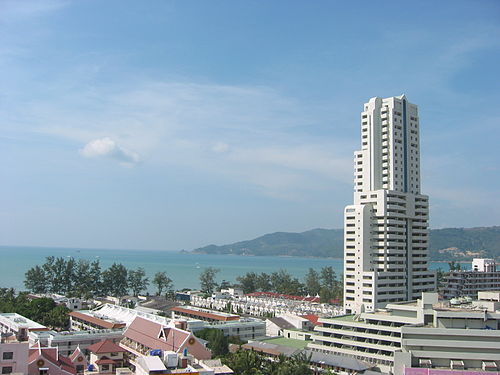
Patong, for the record, is exactly what I thought, and we went once, for dinner, and left before Bangla Road woke up properly, which suited both of us more than Tom will admit. Kata is the beach we kept going back to, a long curve with real waves and a shaded end where the longtail boats pull up, their prows wrapped in coloured cloth and flowers for luck. Nai Han, at the very bottom of the island, is quieter again, and from there it is a ten-minute drive to Promthep Cape for the sunset. Everyone goes. There is a car park, and a man selling corn, and a hundred people with their phones up, and then the sun goes into the Andaman Sea in about four minutes flat and the whole headland applauds. We applauded. It is impossible not to.
Tom did a day of diving at Racha Yai, an hour out by boat, and came back with a face I have only seen on him at the football. I did the snorkelling at Ya Nui instead, a tiny bay between two headlands where you walk in off the sand and the reef starts at your knees. The day up at Khao Lak was the surprise: long empty beaches on the mainland north of the island, casuarina trees, hardly anyone, and the memorial to the tsunami that reminds you why the beaches were empty for a long time.
What I know now
Go in the dry season or do not go. Stay south, go north for the day. Book the canoe trip before the speedboat, because after the hongs the speedboat feels like a bus. Cover your shoulders for the Buddha and your ears for Wat Chalong. And give the island the week it needs, because the loud bit is one road, and the rest of it is a place I would go back to without Tom winning anything.

Places in this story
- On the water. Phi Phi Islands speedboat day (Maya Bay viewing, snorkel stops), Phang Nga Bay sea canoe tour and James Bond Island, scuba diving at Racha Yai, snorkelling at Ya Nui Beach.
- On the island. Big Buddha, Wat Chalong, Phuket Old Town and the Sunday walking street on Thalang Road, an elephant sanctuary, Patong, Kata Beach, Nai Han Beach and Promthep Cape at sunset.
- Beyond. a day at Khao Lak on the mainland; a day at Ao Nang on the Krabi side.
- When. December, the start of the pleasant months (December to April); daytime highs around 28 °C.
Mia and Tom are a Trip720 travel profile, not customers: an imagined journey through real places, written from the Phuket guide and the place as it is.
More on Phuket: the Phuket from Australia guide · More from Mia and Tom